

September 22, 2026
September 22, 2026
7 Market Research Tools & How to Use Them

By
Liz White

The Modern Market Research Tool Stack
Are you being asked to make your research leaner, more agile? Build smarter toolkits? Do more with the same budget?
What's available to research teams looks very different in 2026 than it did even two years ago. Insights teams face a new kind of pressure: an explosion of AI-powered platforms promising faster, cheaper, and more automated research alongside growing skepticism about whether speed and automation can deliver the depth that drives real business decisions.
The result is a bifurcated market. On one side: platforms racing to automate research workflows with AI. On the other: a growing recognition that the most valuable insights, the kind that change strategy, win markets, and reveal the ‘why’ behind consumer behavior, still require human expertise that no algorithm can replicate.
The most effective research programs in today’s world understand the difference and build their tool stacks accordingly. This guide covers seven types of market research tools that represent the best of both worlds: purpose-built categories that help insights professionals deliver high-quality, high-impact results on timelines and budgets that work for modern teams.
7 Types of Market Research Tools for 2026
2026 has introduced a new complexity: the rise of AI in market research and research automation. Platforms now promise to replace human moderators with AI interviewers, generate insights from automated surveys, and deliver instant analysis from unstructured data. Some of these capabilities are genuinely useful. Others obscure a critical trade-off: speed at the expense of depth.
As a modern insights professional, you're constantly figuring out what your toolkit looks like today, and who's in it. That means having partners built for everything from a quick, directional read on a handful of questions to the larger, higher-stakes initiatives mapped out across your year. Some days, “good enough” is exactly the right call to keep momentum going. Other days, you're shaping brand strategy where quality and rigor can't be the thing you compromise on.
The seven types below reflect this philosophy. They span:
• Human-moderated qualitative research
• AI-moderated interview platforms
• Quantitative survey and validation
• Participant recruitment
• AI-powered secondary research and competitive intelligence
• Social listening and brand monitoring
• Insight storytelling and asset creation
The good news: there's a time and place for all of it. It's just about picking up the right tool for the job at hand.

The solutions below represent a modern research stack built for speed, quality, and real business impact. They cover everything from expert-moderated qualitative research to competitive intelligence, presentation design, and stakeholder communication.
1. Expert-Led Qualitative Research
Some decisions are too expensive to get wrong based on a directional read alone: a product launch that needs board sign-off, a repositioning that touches years of brand equity, a message tested with an audience your team doesn't have built-in fluency with. These are the moments that actually call for human-led qualitative research, a trained moderator, able to follow an answer wherever it actually leads instead of wherever a script assumes it would go.
This is the category built for depth over speed. A skilled moderator can catch the contradiction between what someone says and how they say it, read a hesitation as data instead of noise, and adjust a line of questioning mid-conversation based on something no discussion guide anticipated. For work where the finding needs to hold up in a boardroom, and still hold up a quarter later, that's not a nice-to-have. It's the whole value.
How It Helps
Human-led qualitative research earns its place in the toolkit whenever the cost of misreading a consumer is higher than the cost of the research itself. A live moderator can adjust a question in real time based on what someone just said, notice when body language contradicts an answer, and catch a cultural or category nuance a script would miss entirely. None of that is available after the fact. It has to happen in the room, in the moment, or it doesn't happen at all.
That's why this method still anchors the highest-stakes work on a team's calendar: a repositioning that has to hold up across a multi-year plan, a product decision that can't be walked back once it ships, a message tested with an audience your team doesn't already understand well. The output isn't just an answer, it's the reasoning behind the answer, and that reasoning is what actually reduces risk on a decision leadership has to defend.
Best For
- A decision with real consequences if the finding turns out wrong, not just a directional check
- An audience or category your team doesn't already have built-in fluency with
- A finding that needs to hold up to scrutiny in a boardroom, not just confirm a hypothesis
- A question where the reasoning behind the answer matters as much as the answer itself

2. AI-Moderated Interview Platforms
This is the category that barely existed two years ago and now sits in most research toolkits. These platforms use a scripted or adaptive conversational interface to collect qualitative-style responses at a volume and speed no human moderator could match.
How It Helps
AI-moderated tools are well suited to broad directional reads with lower stakes: a first pass at concept reactions across a large sample, or an early read on whether an idea is worth exploring further. They follow a script rather than a genuine instinct for when to push on an answer. It’s fast, it’s short, it’s contained to the predetermined set of questions you had going in. Synthetic respondent panels, which generate plausible answers from a model rather than a live person, have started to sit alongside this category as a faster, cheaper option for very early, low-stakes directional checks, worth knowing about, though speed and truth aren't always the same thing.
Best For
- Broad directional reads across large samples
- Early-stage concept or message screening before committing to a full study
- Situations where an inconclusive or slightly-off answer costs very little
3. Quantitative Survey & Validation Tools
When you need reliable data to validate hypotheses and measure market opportunities, this category provides the statistical backbone for confident business decisions. The strongest platforms bring decades of research best practices to survey design, enabling teams to create, launch, and analyze surveys in hours, not weeks.
How It Helps
Modern quantitative platforms remove the complexity of survey research without sacrificing methodological rigor, often building in projective and enabling techniques grounded in behavioral science, plus advanced analytics like MaxDiff and TURF for trade-off and reach analysis. That combination lets research teams make fast, statistically confident decisions.
Best For
- Market sizing and opportunity assessment at statistical confidence
- Product concept testing and validation across large samples
- Brand tracking and competitive benchmarking over time
4. Participant Recruitment Platforms
Research quality is only as good as the participants behind it. This category provides the recruitment infrastructure that powers successful studies across methodologies, connecting researchers with large, pre-screened participant pools and advanced fraud detection that protects the integrity of the research.
How It Helps
Recruiting the right participants is one of the most underestimated variables in research quality. These platforms solve recruiting at scale, giving teams access to verified, engaged participants who represent real target audiences rather than professional survey-takers. Screening and verification directly impact the reliability of the data and, ultimately, the quality of the business decisions that follow.
Best For
- Recruiting niche or hard-to-reach audiences traditional methods struggle to access
- Managing complex scheduling for multi-session qualitative studies
- Ensuring participant quality for high-stakes research

5. AI-Powered Secondary Research & Competitive Intelligence
Before you design a primary research study, you need to understand the market context you're operating in. This category functions like a research analyst for secondary intelligence, synthesizing information from hundreds of sources in real time, with citations for verification.
How It Helps
These tools enhance primary research by surfacing the market context that informs better study design: competitive positioning, emerging category trends, and regulatory developments that shape how consumers think and behave. Research teams use them before a study to sharpen hypotheses, and after a study to triangulate primary findings against broader market intelligence. The strongest platforms in this category now offer deep, multi-source synthesis that goes well beyond a standard search, producing structured briefs on complex questions in minutes.
Best For
- Secondary research to inform primary study design and hypothesis development
- Competitive landscape mapping and market context for consumer research
- Pre-study briefing and post-study triangulation of findings

6. Social Listening & Brand Monitoring
Structured research tells you what consumers say when you ask. Social listening reveals what they say when no one's watching. This category gives insights teams access to authentic, unsolicited consumer sentiment at a scale no primary research program can match, processing millions of online conversations in real time with AI-powered sentiment detection.
How It Helps
Teams that rely exclusively on structured research miss a critical data source: the authentic, unprompted consumer voice in social conversations, reviews, and community discussions. Modern platforms in this category now identify patterns and emerging trends with a level of sophistication that goes well beyond keyword monitoring, enabling proactive trend detection and early crisis identification before a formal study is even designed.
Best For
- Real-time brand reputation monitoring and early crisis detection
- Identifying authentic consumer sentiment beyond what surveys capture
- Competitive intelligence and emerging trend identification
7. Insight Storytelling & Asset Creation
Research only creates value once someone acts on it. This category closes that gap, turning research outputs into executive-ready presentations, highlight reels, and stakeholder assets. It spans both AI-assisted presentation design and AI-powered video and voice-of-customer editing.
How It Helps
Research teams often face a communication bottleneck: hours of findings get compressed into a deck that doesn't do justice to the work, or six hours of video footage that never gets watched by the people who need to see it. Tools in this category eliminate the design and editing overhead so researchers can focus on the narrative, feeding in findings and getting back presentations and highlight reels that get attention in boardrooms and strategy sessions.
Best For
- Creating executive-ready presentations from complex research data
- Building consumer testimony libraries and voice-of-customer highlight reels
- Communicating findings to stakeholders who weren't present during data collection
How Studio Fits Into Your Toolkit
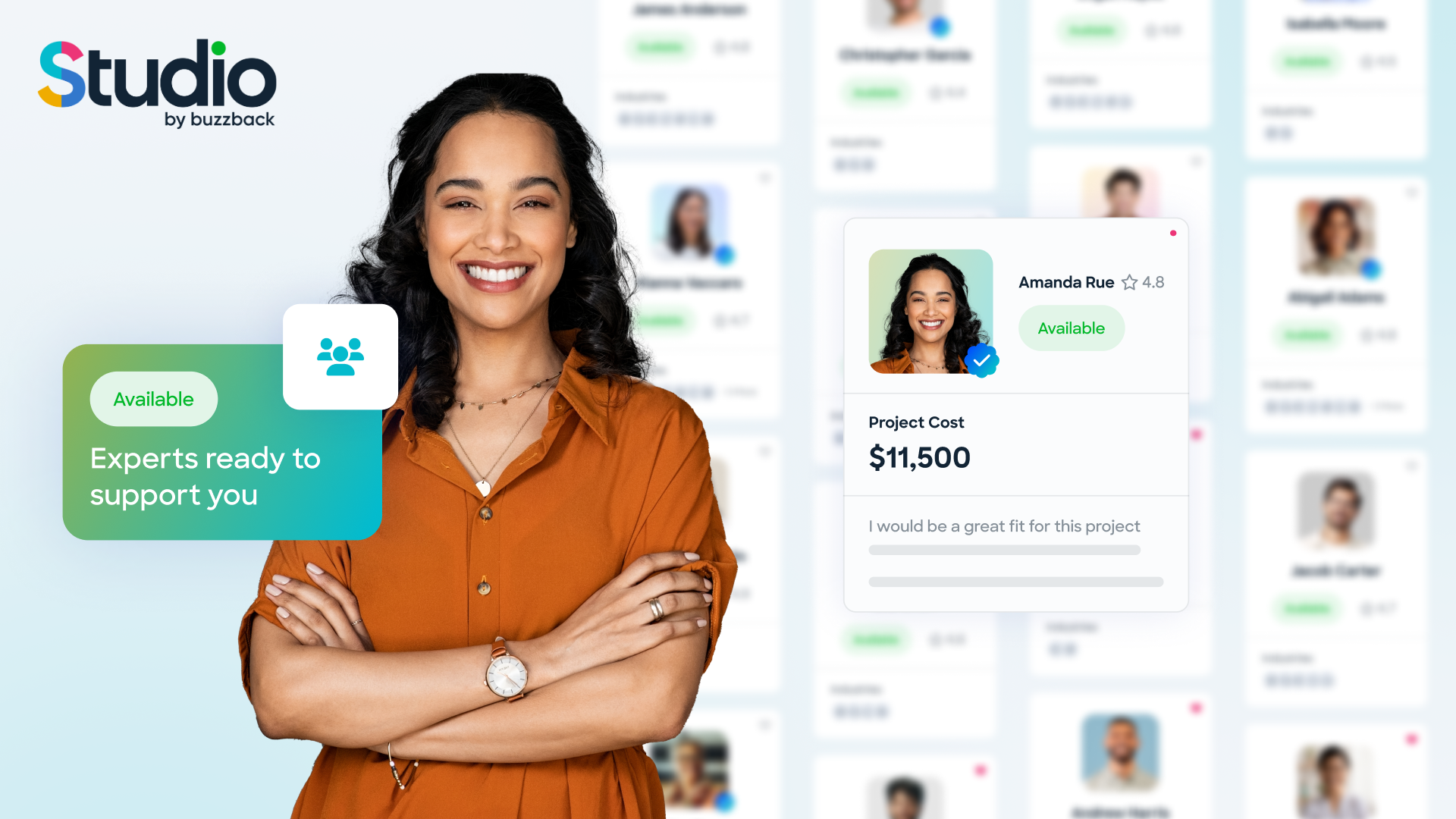
Studio exists for the first type on this list: research questions serious enough to need a trained moderator, without the overhead of a full agency engagement. When you need to understand the 'why' behind consumer behavior, Studio provides access to the expert-led qualitative research that drives the most consequential business decisions.
Every project is staffed with a moderator who has run studies in the category before, matched through Studio's vetted network, at a pace built for how research teams actually work now.
Studio isn't meant to replace the rest of the toolkit covered in this guide. It's built to sit alongside other tools and quant platforms as the layer that handles the decisions too important to hand to a script.
Building a Research Stack That Scales
The seven types of tools in this guide form a complete ecosystem for modern market research, from secondary intelligence and participant recruiting through expert-moderated qualitative research, quantitative validation, social listening, and stakeholder communication.
The businesses that make the best decisions in 2026 are not necessarily the ones with the most data or the fastest AI tools. They're the ones who know exactly what's in their toolkit and who's in it, matching the right partner to the job in front of them instead of reaching for whatever's already open.
That's the whole idea behind building a toolkit instead of just collecting tools. Some days, a quick, good-enough read is exactly the right call to keep momentum going. Other days, you're shaping the brand strategy where quality and rigor can't be the thing you compromise on. Knowing the difference, and knowing who to call for each one, is what actually scales.

Frequently Asked Questions
What is market research?
Market research is the structured process of gathering, analyzing, and interpreting data to understand your target market, identify trends, and decode consumer behavior. Effective market research combines multiple methodologies, qualitative and quantitative, primary and secondary, to build a complete picture of consumer motivations, market dynamics, and competitive positioning that inform confident business decisions.
How do I decide when to use AI research tools versus human-led research?
Use AI tools for tasks where speed and scale create clear value without sacrificing outcome quality: secondary research synthesis, quantitative survey analysis, social sentiment monitoring, presentation creation, and video transcription. These are areas where AI handles operational complexity efficiently.
Preserve human expertise for research where the quality of interpretation determines the value of the output: moderating focus groups and in-depth interviews, designing complex qualitative methodologies, analyzing findings that require cultural or emotional nuance, and translating consumer insights into recommendations leadership can act on. For high-stakes decisions, the difference between AI-generated analysis and expert human moderation is the difference between data and insight.
What's the difference between qualitative and quantitative research tools?
Qualitative research tools focus on understanding consumer motivations, emotions, and decision-making processes through methods like focus groups, in-depth interviews, and ethnographic studies. They excel at revealing the why behind behavior, the human factors that quantitative data can identify but not explain.
Quantitative research tools measure and quantify consumer behaviors, preferences, and market characteristics through surveys and statistical analysis. They provide the numerical foundation for market sizing, concept validation, and trend measurement with statistical confidence.
The most effective research programs use both. Qualitative research identifies the right questions and provides context for interpreting quantitative findings. Quantitative research validates qualitative insights across larger populations and provides the confidence needed for major business decisions.
Your toolkit is only as strong as the option you skip because it's inconvenient. Studio makes sure human-led qualitative research is never that option: vetted expert moderators, integrated project management, and studies that move at the pace your team actually needs.
Book a demo to see how leading brands are already building it into theirs
By
Liz White
Subscribe
Stay up to date on industry insights and resources from Studio.


