

August 24, 2026
August 24, 2026
And Just Like MySpace, Immersive Qualitative Research Is Making a Comeback

By
Liz White

The Instinct No One’s Naming
MySpace's owners just confirmed, in a new documentary, that the platform is coming back. There's no launch date. There's no product to look at yet. And still, the reaction has been immediate: people redrafting their Top 8 and mourning glitter graphics that haven't existed in over a decade.
That reaction is about something people have been missing without a name for it: the feeling of authentic connection, instead of letting a feed decide what you see and when.
This is a correction, a pushback against years of everything being optimized purely for convenience. And it's happening in research too, where ethnographic research and other immersive qualitative research methods are getting a second look after several years of losing ground to anything that promised an answer faster. For insights teams, the useful takeaway has nothing to do with MySpace itself. The benefits of qualitative research done this way are earning their place back in the toolkit, and understanding why is worth more than the trend that made it visible.
Why Fast Research Won an Argument It Shouldn't Have

AI-moderated interviews, synthetic panels, and self-serve platforms earned their place in the toolkit honestly. They're faster and cheaper, and for a lot of questions, that's genuinely enough. A quick read on packaging preference or a directional gut check doesn't need six weeks in the field, and pretending otherwise wastes everyone's budget.
The problem is what happened next. Speed stopped being one option among several and became the default setting, the thing you had to justify not choosing. Ethnographic research, in-depth interviews, and other immersive qualitative research methods got recast as the slow, expensive option, worth defending rather than worth choosing.
That framing was always backwards. Fast methods are good at confirming what you already suspect. They're not built to catch the assumption that was wrong from the start, the kind of blind spot that only shows up when someone spends real time watching behavior instead of asking about it.
What Ethnographic Research Actually Solves
Ethnographic research is built on a simple premise: people are often unreliable narrators of their own behavior. Habits are hard to describe from the outside, which has little to do with honesty. Someone can tell you they read ingredient labels carefully. Watching them shop tells you whether that's actually true.
Researchers call this the say-do gap, the distance between what a person reports and what they actually do. It's the reason ethnographic research and in-depth interviews exist as distinct methods from a standard survey. A self-report captures the story someone tells about their behavior. Ethnographic research captures the behavior itself, in the environment where it actually happens.
For an insights team, the practical takeaway is straightforward. Any question that depends on understanding a routine or an emotional undercurrent is a question a self-report is poorly equipped to answer on its own. Surveys and fast methods still have their place. Some questions were just never going to be answered honestly by asking them directly.

The Benefits of Qualitative Research That Speed Alone Can't Deliver
The benefits of qualitative research show up clearest in methods built for real immersion. Three stand out.
It Closes the Gap Between What People Say and What They Do
Self-reported behavior is filtered through memory, self-image, and whatever answer feels reasonable in the moment. Ethnographic research removes the filter by watching behavior as it happens, which is why it routinely contradicts what the same people said in an interview five minutes earlier. This is the reason most often cited by research teams for choosing ethnographic methods over a self-report alone: the findings survive contact with what people actually do.
It Surfaces Context No Interview Can Reconstruct
A kitchen counter covered in half-used products tells you more about a skincare routine than a participant's own summary of it. Immersive qualitative research methods capture the physical and situational context, the clutter and timing, that shapes a decision but rarely makes it into a self-report. Teams relying only on interviews often miss this layer, simply because the context isn't in the room to see.
It Builds a Kind of Closeness a Chart Can't
Findings anchored in a real scene, a person's actual kitchen, their real hesitation at a shelf, travel through an organization differently than a statistic does. Stakeholders remember the story and trust the decision behind it in a way a percentage rarely earns on its own. A finding that a room believes is a finding that gets acted on.
Five Signals a Question Needs Deep Immersion
Not every project needs ethnographic research, and treating every question like it does is its own kind of waste. But a handful of signals reliably point to a question that a fast method will answer confidently and wrong.
1. The Honest Answer Is “We're Not Sure Why”
If your team can describe what's happening but not why, that's usually a sign the reason lives somewhere a self-report can't reach, a routine or a workaround nobody thought to mention out loud.
What this looks like in practice: A beverage brand saw trial rates climb but repeat purchase stall, and no survey question could explain the gap. Two in-home ethnographic sessions later, the answer was sitting in the refrigerator door: the product didn't fit, so it got pushed to the back and forgotten. No amount of asking would have surfaced that. Someone had to see the shelf.
2. The Behavior Contradicts the Self-Report
People aren't lying when they describe their own habits inaccurately. They're just bad narrators of things they do on autopilot. When stated behavior and actual behavior diverge, that gap is usually the whole finding.
What this looks like in practice: Parents in a nutrition study consistently reported reading labels before buying snacks for their kids. Observation told a different story. Labels were checked once, the first time a product was purchased, and rarely again after that. The insight wasn't about label design. It was about how quickly trust gets established and how little scrutiny follows it.
3. The Decision Is Expensive Enough to Be Wrong Slowly Instead of Right Fast
A launch decision or a category entry carries enough downside that the cost of an extra few weeks of fieldwork is trivial next to the cost of building on a wrong assumption.
What this looks like in practice: A CPG brand preparing a category entry ran a fast concept test that scored well across the board. A smaller ethnographic study before launch found that the product solved a problem people didn't actually experience the way the brand assumed. The positioning changed before a single unit shipped.
4. The Category Is New Enough That You Don't Know What You Don't Know
Fast methods work well when you know which questions to ask. Ethnographic research earns its keep precisely when you don't, because it surfaces the question you hadn't thought to include in the guide.
What this looks like in practice: A wellness brand trying to understand a new customer segment discovered, only through in-home visits, that the product was being used in a completely different daily routine than the one it was designed around. No discussion guide had a question that could have surfaced this, because no one on the team knew to ask it.
5. The Question Can't Be Answered in a Straight Line
Some questions only make sense to ask after hearing the answer to a different one. A fixed list of questions, run in sequence, catches the surface. It won't catch the thing that only comes up because of what someone just said a minute earlier.
What this looks like in practice: A financial services brand wanted to understand why customers kept delaying retirement planning. A standard survey could ask about age, income, and stated priorities, and it did, without explaining anything. The real answer only surfaced when a moderator followed one participant's offhand mention of a parent's health scare into a line of questioning nobody had planned for. No fixed sequence would have known that thread existed, let alone where to find it.

Where Teams Get This Wrong
Assuming a short video response does the same job as an immersive session. A 10-15 minute async video clip can capture a stated opinion. It can't build the rapport, follow-up, or contradiction-catching that an immersive moderated session depends on. Treating the two as interchangeable is how teams end up with a tidy soundbite standing in for the messier, more useful truth underneath it. AI moderation can ask the planned follow-up question. It doesn't know there's a fourth question worth asking, the kind that only shows up in a real session, not a short one.
Choosing scale over closeness. There's real pressure right now to run qual at scale: more respondents, broader reach. Sometimes that's the right call. But when the actual question needs depth, a contradiction only a single participant can surface, the pause before an honest answer, choosing scale instead trades away the reason to run qual in the first place. The findings still arrive. They just describe the surface of something without ever reaching what's underneath it.
Choosing the method to match the budget instead of the question. A quick pulse check and a question about why a product isn't landing with a new audience are not the same research problem, and they shouldn't reach for the same tool just because one is already licensed. This usually traces back to how the project was scoped, which is fixable earlier in the process than teams realize.
How to Know Whether Your Next Project Needs This
A useful gut check: pull the last five research projects your team ran and ask which came first, the question or the tool. If the tool came first in most of them, speed has quietly become the default rather than a deliberate choice.
The signal worth watching for is the shape of the question itself. A quick read on packaging preference or a directional gut check rarely needs someone in a participant's home for two hours. A question about why a product isn't landing with a new audience usually does. That's the distinction worth building into how a project gets scoped, before a method gets chosen rather than after.
MySpace's relaunch will come and go, and most people won't remember exactly why it mattered by next year. The instinct behind it will still be there, because it was never really about a website. People are already showing they'll spend money or attention on things that take real effort to build. Research is no different. The questions worth answering slowly are still worth answering slowly, no matter how fast everything else gets.
Where Studio Fits
This is exactly the gap Studio was built to close. Our network includes 50+ vetted moderators, each with a profile covering methodology specialties and client-verified reviews, so finding someone who can run real ethnographic fieldwork or in-depth interviews doesn't take a leap of faith. Every moderator goes through a four-step vetting process before they ever touch a live project.
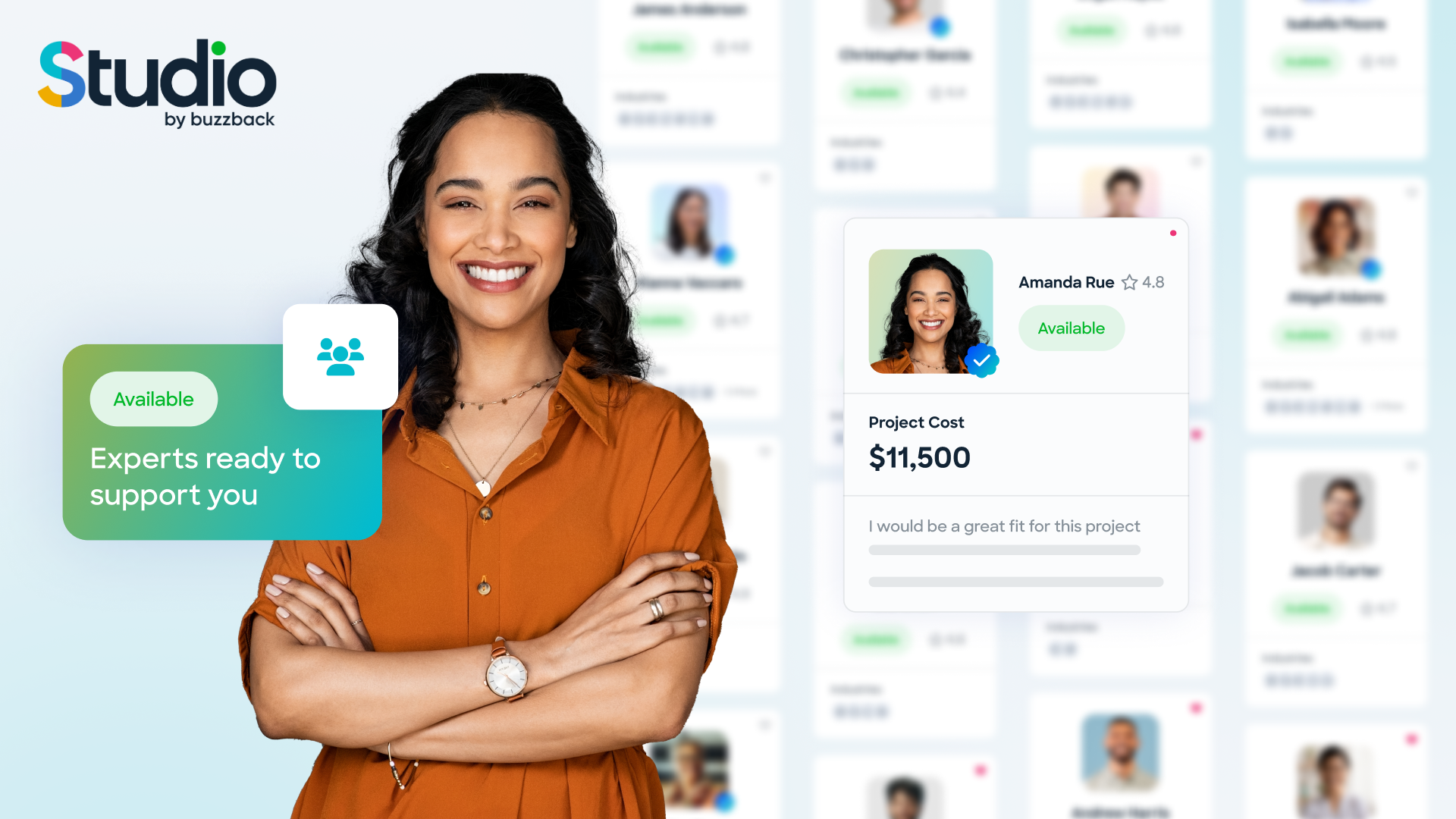
Fast methods and immersive ones both belong in the toolkit. The job is making sure the choice between them gets made on purpose. Studio's platform gets you from RFP to a matched, vetted moderator in 48 hours, so choosing depth doesn't have to mean falling behind.
Browse Studio's moderator network and filter by the expertise your next project actually needs.
By
Liz White
Subscribe
Stay up to date on industry insights and resources from Studio.


